LENKA: The Czech Train-Tram That Could Redefine Regional Rail
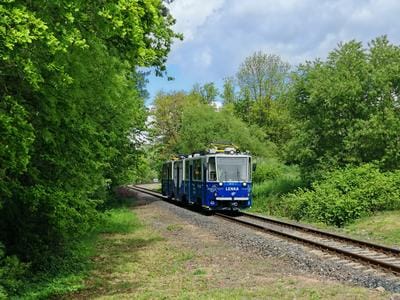
An old tram from Brno. A disused rural railway. A bold engineering team willing to challenge decades of conventional railway thinking. Together they have created one of Europe's most intriguing rail innovation projects.
When the blue articulated vehicle called LENKA quietly rolled onto the rural railway between Dolní Bousov and Kopidlno in July 2026, it was much more than another railway test. It represented a serious attempt to answer one of the biggest questions facing regional railways across Europe:
How can low-density railway lines remain economically viable without sacrificing quality, sustainability or passenger comfort?
A Tram Becomes a Train
At first glance, LENKA looks like an ordinary articulated tram. And, in fact, it once was.
The vehicle began its life in the city of Brno as a KT8D5 tram. Instead of scrapping the vehicle after decades of urban service, Czech railway technology company AŽD decided to give it an entirely new mission.
The transformation was anything but cosmetic
Engineers redesigned the bogies for railway operation, installed railway wheel profiles, integrated railway signalling equipment, GSM-R communication, vigilance control, railway couplers, new lighting systems and numerous safety modifications. At the heart of the vehicle sits a 192 kWh battery system, allowing completely emission-free operation without overhead electrification.
The project required an investment of roughly CZK 12 million, remarkably modest compared with the cost of purchasing a brand-new regional multiple unit.
More Than a Demonstrator
LENKA is an acronym for Light Electric Rechargeable Rail Vehicle ("Lehké Elektrické Nabíjecí Kolejové Vozidlo AŽD").
But the project is far more than an engineering exercise.
AŽD's objective is to demonstrate that lightweight battery-powered vehicles derived from tram technology can provide an economically attractive alternative for regional railways carrying relatively few passengers.
Many European branch lines face a difficult future. Traditional diesel multiple units are expensive to purchase, maintain and operate. Full electrification is often economically unjustifiable. Closing railway lines, however, frequently removes an essential transport link for rural communities.
LENKA proposes a different solution:
- lower vehicle weight,
- lower energy consumption,
- lower acquisition costs,
- lower maintenance costs,
- zero local emissions,
- and the possibility of extending services beyond conventional railway infrastructure.
Testing on the "Kopidlnka"
The experimental vehicle is currently being tested on the privately owned railway between Dolní Bousov and Kopidlno, affectionately known as the Kopidlnka.
This line has become one of Europe's most unusual railway laboratories.
After purchasing the former state-owned branch line in 2013, AŽD transformed it into a real-world test track for innovative railway technologies. It has already hosted Europe's first autonomous railway operation ("Edita"), and LENKA is the next milestone in this growing innovation ecosystem.
The current test programme, authorised until the end of 2027, is intended to verify every aspect of railway operation, including:
- running behaviour,
- braking performance,
- battery operation,
- railway safety systems,
- operational reliability,
- and long-term maintainability.
Performance Designed for Regional Rail
Despite originating as an urban tram, LENKA possesses surprisingly suitable characteristics for regional operation.
The vehicle achieves:
- battery range: approximately 50–80 km, depending on operating conditions,
- battery capacity: 192 kWh,
- maximum operating speed: 60 km/h,
- rapid battery charging,
- bidirectional operation,
- full electric propulsion without overhead wires.
For many lightly used branch lines, these figures are entirely sufficient.
Rather than competing with high-speed trains, LENKA targets precisely those routes where conventional railway vehicles often represent excessive capacity and excessive cost.
The Missing Piece Is Not Technology
Interestingly, the greatest challenge is no longer engineering.
The vehicle itself works.
The remaining obstacle is legislation.
Current Czech—and largely European—railway regulations do not yet provide an appropriate legal framework for routine passenger operation of this type of train-tram vehicle on the national railway network.
Consequently, LENKA currently operates without passengers during the official testing programme.
Once all safety evidence has been collected, AŽD intends to apply for approval to carry passengers. Parallel discussions with the Czech railway authorities and the Ministry of Transport are expected to determine whether existing legislation should evolve to accommodate this entirely new vehicle category.
A Different Philosophy
Perhaps the most remarkable aspect of the LENKA project is its philosophy.
Instead of commissioning years of theoretical feasibility studies, AŽD decided to build a real vehicle and test it under real operating conditions.
As AŽD management has repeatedly emphasized, the objective is not simply to publish another report—it is to generate practical experience and evidence that can guide future railway policy.
This pragmatic approach has attracted considerable attention throughout the Czech railway community.
Looking Beyond the Railway
The long-term vision extends well beyond today's demonstration line.
If legislation eventually permits true train-tram operation, vehicles similar to LENKA could potentially travel:
- on regional railway lines,
- directly into town centres,
- to multimodal transport hubs,
- or to suburban districts currently lacking efficient rail access.
Such concepts have already proved successful in cities including Karlsruhe and Kassel, although those systems rely on purpose-built train-trams. LENKA explores whether an even more economical approach—based on recycled tram technology and battery propulsion—could make similar concepts accessible to smaller regions.
A Small Vehicle with Big Ambitions
Europe's regional railways face increasing financial pressure. Rising operating costs, ageing rolling stock and decarbonisation targets require new thinking rather than incremental improvements.
LENKA does not claim to solve every problem.
It will not replace mainline trains, nor is it intended for high-capacity commuter corridors.
Instead, it offers something arguably more valuable: a fresh perspective on how lightly used railway lines might survive—and even flourish—in the coming decades.
Sometimes innovation is not about building something entirely new.
Sometimes it begins by looking at an ageing tram and asking a deceptively simple question:
What if this could become a train?
If LENKA's ongoing trials continue to demonstrate safe, reliable and economical operation—and if the regulatory framework evolves accordingly—the answer may reshape the future of regional rail transport, not only in the Czech Republic, but across Europe.
See also:
https://www.drehscheibe-online.de/foren/read.php?030,11459387